Inventions, creations, and innovations
Built by Berg
Nick's circuit boards were cardboard and duct tape. His logic gates were hand-soldered transistors. Most of what he built was meant to teach something, and some of it even worked when you wanted it to. A few of the devices below have been rebuilt here in JavaScript so you can press them.
Know of another Berg creation? Write to fund@nickberg.org. There is also a short film about Nick if you would rather watch than read.
Door Alarm
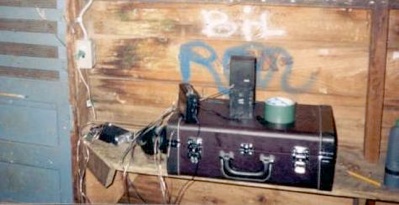
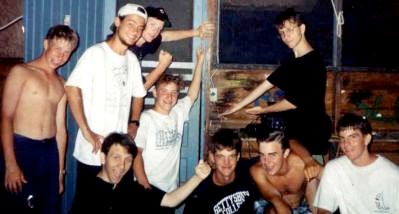
My first memorable experience with Berg was the unforgettable improvised alarm system devised with a piece of scrap aluminum foil and a jury-rigged Walkman to protect our cabin from undesirables at band camp. We were the only cabin with a prank deterrent system. It even worked the one and only time an instructor walked in.
No girls were gonna sneak into our cabin! Perhaps it worked too well.
Luke Lorenz, Boalsburg, PA. Photos thanks to Brian Hamrick.
Invert Alert
The Invert Alert was a neat little device that Nick created for his grandma to wear around her neck. It used a motion-sensing switch and a position-sensing switch together to detect a fall, which would involve acceleration, a quick arrest, and a change of position. It then broadcast a signal that made the home's doorbell sound. The doorbell was next to where his grandfather sat, so he would know either that Grandma had fallen or that someone was at the door leaning on the bell.
Thomas Clardy
There were other versions of the Invert Alert. Nick had one that scrambled all transmission signals in a localized area. So if the TV got fuzzy, or the radio, or the portable phone, you had better check on Grandma.
Berg demonstrated this device during a stage production at Henderson High School. The sound techs used walkie-talkies to talk to the stage manager. Imagine the confusion when every headset filled with static. He gave a humorously repentant look and turned it off.
Random Number Generator
Berg made a duct-taped box with circuits and red LEDs that came up with random combinations whenever you pressed the two extended wires to your skin. The lights were lined up, and the way they lit indicated a number in binary.
For those unfamiliar with binary: we are used to counting eight, nine, ten. Ten is really a one in the tens place and a zero in the ones place. In binary you can only get to 1 in any place. Add one and the one moves to the left: 000 plus one is 001, plus one is 010, plus one is 011. Add one more and you carry, just like in base ten, and get 100. So 001 is one, 010 is two, 011 is three, 100 is four, and so on.
If you use this system with your fingers you can count to 31 on one hand, and to 1023 with two. Don't try this at home, kids. You might go crazy.
The Truth Detector
A later model of the Random Number Generator was the Truth Detector. The device used the resistance of your skin, when you touched the two wires, to come up with different light combinations based on how truthful you were. Did it really work? Well, before I answer that, let me get my Truth Detector.
It was simply soldered transistors and logic gates with an LED display. The name was whimsical. We guessed that a higher number meant more truth and a lower number meant less, but really the Truth Detector was designed as a toy, to stir creativity and spark an interest in electronics. Berg taught circuit building, among other things, at Summer Science classes in the West Chester Area School District under the direction of Mr. Jim Wakefield. Nick built and gave me a similar device for my birthday. At the time I could not read binary, and now I can.
Most of Berg's inventions had a didactic quality while stirring the imagination. Some were so complex that we could hardly understand the theory he was trying to convey, much less the engineering of the device. And some never worked when you wanted them to, like the huge "Pyramids of Power" speakers that Berg brought in for a dance at the high school. Needless to say, there was more laughing than dancing, as we could not hear the music.
Luke Lorenz
Results are generated by logic gates of questionable integrity. Higher is truer, probably. Like the original, it sometimes plays the door alarm instead, and sometimes it just breaks.
Conway's Game of Life, in transistors
Nick made many modular cells. Each cell was a circuit of transistors and an LED, built on Nick's patented cardboard and duct tape circuit boards. The LED indicated alive or dead. The status of the LED was controlled by a simple logic circuit that made a decision based on the alive or dead status of the neighboring cells.
He would hook the cells up in an array, and by poking a wire into a junction in each cell he could make it alive or dead. Once he set it up, he turned on a clock circuit that made the whole thing iterate through its lifespan. The clock could be adjusted so you could watch the life cycle slowly or quickly.
What was cool is that Nick did it purely with transistors. That meant he had to construct logic gates from scratch, using several transistors for each gate. Each cell probably used ten or so gates, which meant twenty or thirty transistors per cell. That is a lot of soldering, planning, and repetition.
Justin "Jut" Olexy. Joe Blechman adds that he made the whole thing out of LEDs and understood the theory, but as for Nick's electrical wiring, has only a vague memory.
The rules: a lit cell with two or three lit neighbors stays lit. A dark cell with exactly three lit neighbors lights up. Everything else goes dark. The panel starts with a glider that travels, a blinker and a toad that flip back and forth, and a block that never changes. More about the Game of Life.
Bovl Blocks
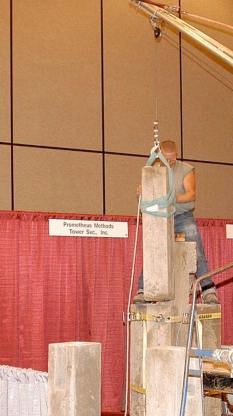
Nick's tower design is incredible. They are poured-form concrete blocks that assemble to form a tower. They are internally guyed, making it a "three wire, internally guyed concrete block tower." Running through the center of each outside block, but not the center key blocks, is a narrow PVC pipe that the guy wire runs through. The guy is then attached to a steel frame sitting on the ground and tensioned down with a wrench.
Nick first demonstrated this tower design to the world at a conference in Hershey, PA, on October 30, 2003, the 19th annual meeting of the Pennsylvania Association of Broadcasters. I was there with him and feebly helped in whatever way I could to assemble the tower.
Thomas Clardy
The idea was a tower that could be cast on site, from local materials, anywhere steel was hard to ship. Nick thought it would be especially useful in the African interior, where cellular networks were just beginning to be built out.